Alumni working in the field of athletics discuss ways injuries can be prevented by athletes and dancers.
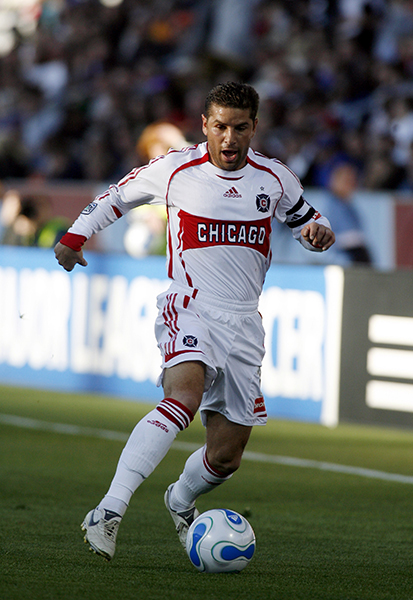
Chris Armas ’94
Photo Credit: Byron Hetzler, USA TODAY Sports. ©2007 Byron Hetzler
Chris Armas ’94 stood just three games away from representing the United States in the biggest sporting event in the world. Armas, a former star in Major League Soccer and a member of the ÃÛѿTV Athletics Hall of Fame, had been selected as a member of the U.S. National Team that would compete in the 2002 World Cup in South Korea and Japan. But in the first of Team USA’s three exhibition games before the World Cup, a match against Uruguay at Robert F. Kennedy Memorial Stadium in Washington, D.C., it happened.
“I made a movement to try to steal the ball—a movement I had made a million times—and my right knee buckled,” Armas said. “I played another 15 minutes or so. But I knew something wasn’t right. I went to the bench and had the team physician check my knee out. He did a test on it and told me I had a torn ACL [anterior cruciate ligament]. I went to the hospital and an MRI confirmed it.”
The news devastated Armas. On one seemingly innocuous play, he went from an athlete preparing to perform in his sport’s marquee event to a forgotten man.
Many performers, be they athletes or dancers, have experienced a similar fate: An injury deprives them of their unique gift and source of pride and passion.
Could the injury have been prevented? If so, how? What types of injuries are more likely to threaten a performer’s career? When injured, to whom should a performer turn for help? And will the performer ever be the same again?
Such questions play on a performer’s mind during the lonely days and nights of rehabilitation. Armas experienced it as a world-class athlete. For three years, he experienced it as the coach of Adelphi’s women’s soccer team, which posted a 14- 3-4 record in 2014 and made the Northeast-10 Conference playoffs.
Armas recently accepted a coaching position with the New York Red Bulls of Major League Soccer, but when he spoke to AU VU he was still coaching at Adelphi and spoke in detail about his efforts to help the women on his team avoid injury.
Women athletes are eight times more likely than men to tear an ACL, according to a study by the National Institutes of Health (NIH).
“Women are more prone to these injuries because of their body type,” said Mike Gavagan, M.A. ’03, Adelphi’s assistant athletic director for sports medicine. “The angle of women’s hips is different from men’s. Also, women have more estrogen, which makes the ligaments a bit looser.”
Other reasons cited by the NIH include: Women tend to run and cut sharply in a more erect posture than men and, after a jump, women tend to bend their knees less.
In a preventative measure, Coach Armas had his players do exercise drills, including squats and dynamic one-legged movements, to get their muscles warm and loose and stretch out the ligaments. Still, one player suffered an ACL tear in 2014, as did three in 2013.
“Aside from the physical pain of an ACL tear, there’s a psychological and mental pain as well,” said Armas, who suffered a staph infection in his injured knee in 2002 and did not play again for a year. “You’re very alone in those moments.”
The Psychology of Performing
Someone who works toward making performers feel less alone and more empowered on their road to recovery is Linda Hamilton, Ph.D. ’89, a former dancer with the New York City Ballet (NYCB) and a specialist in the field of performance psychology.

Linda Hamilton, Ph.D. ’89 talking with dancers at The Ailey School.
Ìý
“There is definitely a loss of identity for the athlete or dancer who is sidelined,” said Dr. Hamilton, whose clients include young dancers in the Alvin Ailey American Dance Theater and athletes. “The loss of identity makes you wonder, `If I’m not a dancer or part of a team, then who am I?’ Another issue is if you have a particularly bad injury, you don’t trust your body any longer. You’re hesitant to make the same move that caused the injury. Sometimes, after an injury, dancers throw themselves back into it and reinjure themselves. And sometimes they hold back, which adversely affects their performance.”
The field of performance psychology did not exist when Dr. Hamilton dropped out of high school at age 16 to join the NYCB. Yet it became a logical second career for her since, as a ballet dancer, she routinely offered support to colleagues who struggled with injuries, anxiety or eating disorders. As Dr. Hamilton, she is a wellness consultant for the NYCB and, with the support of artistic director Peter Martins, she implemented a wellness program which reduced the number of weeks of disability in the NYCB by 46 percent.
“Dancers are similar to athletes—there’s a lot of pressure and there can be problems coping with that pressure,” Dr. Hamilton said. “Oftentimes we create our own problems. A lot of self-sabotage exists among dancers. I try to help them avoid living a lifestyle that doesn’t support their goals—not getting enough rest, not eating right, not giving your body time to recover from an injury, or putting your personal needs aside.”

Sharon Chirban Donohoe, Ph.D. ’93
Those who work in performance psychology say it’s easier to help performers if their coaches believe in the process. Sharon Chirban Donohoe, Ph.D. ’93, whose Boston-based company, Amplifying Performance Consulting, works with athletes and dancers, had a decidedly negative experience with a coach who did not buy in to her guidance.
“I worked with a synchronized swim coach who humiliated swimmers by weighing them in front of everybody and criticizing the ones who gained weight, and when I tried to give the coach some advice on how she should talk to them, she didn’t want to hear it—basically, I was fired,” said Dr. Chirban Donohoe, whose clients include Northeastern University, Harvard University, Boston Ballet and the Boston Marathon. “When I work with an athlete, I tell them, ‘I’m not here to make you change your coach, I’m here to work with you.’”
USA Soccer encouraged Armas to work with a sports psychologist before and after his knee injury. (He tore his other ACL in 2006 while trying to land a spot as an alternate on the World Cup team.) Armas found the sessions “very helpful.”
“I was able to deal with the ups and downs of games and the pressures of soccer better than ever,” said Armas, the USA Soccer Athlete of the Year in 2000 and a Major League Soccer midfielder from 1996–2007.
“Many athletes spend so much time on preparation in areas such as strength and conditioning, skill work, video, nutrition and supplements—but they fail to address one major area: the mind and the power of it,” he said. “Having the ability to cope with mistakes, failure, success, injuries and all that comes with competing can be a major asset.”
Overcoming Anxiety
Although there are distinct differences between athletes and dancers, both groups deal with performance anxiety and the challenge of trying to return to peak form after an injury. Both groups deal with broken bones, stress fractures, and ligament and muscle tears; in addition, athletes face the possibility of concussions while some dancers struggle with eating disorders.
“A Division I basketball player and a ballerina are very similar in how they deal with injuries and rehabilitation,” Dr. Chirban Donohoe said. “There’s anxiety about wanting to get back to what they love to do. Some athletes make terrible patients because when they’re told an injury will take nine months to heal, they think they’ll be like [New England Patriots quarterback] Tom Brady and come back in five or six months. When that doesn’t happen, they get frustrated. The hardest thing is to get an athlete to take it easy.”
Dr. Chirban Donohoe and Dr. Hamilton both earned their Ph.D. in the . Dr. Hamilton has authored three books on performance psychology and writes a monthly column for Dance magazine. Dr. Chirban Donohoe became interested in the field because her three children (a figure skater, a hockey player and a dancer-cheerleader) were involved in youth sports.
“When I work with a client who has suffered an injury, first I normalize the injury,” Dr. Chirban Donohoe said. “If a performer is worried about getting hurt by making the same move again, I let them know that’s normal. If they’re worried about not being able to do everything they once did, I let them know that’s normal. I take them back to class, back to training and the repetition of it and back to the performance. Once they’re back to thinking about the enjoyment of performing, their anxiety level subsides.”
Making Athletes More Efficient
Keeping the bodies of pro basketball players fine-tuned is the work of Ben Kenyon ’06, now in his second season as a sports performance specialist for the NBA’s Portland Trail Blazers. “The speed, quickness and athletic ability of an NBA player are God-given,” said Kenyon, a former star on the Panthers basketball team. “And our goals are to allow them to be as efficient as possible.”
Kenyon devises health and fitness regimens and individual workouts for each of Portland’s 15 players. The workouts focus on improving a player’s speed, strength, explosiveness and quick-jumping ability. “We go through certain movements that mimic what a player would do in a game. We make sure their neuromuscular system is ready. The intensity of the work we do on a game day is much higher than it is on a practice day.”
Whenever Portland plays a home game, Kenyon raises his own athletic intensity by running three miles before reporting to work to better identify with the pushit-to-the-max attitude of a seasoned NBA player. He plans to debut this summer in a half-marathon and a triathlon (swimming, cycling, and running).
Kenyon works with athletes who often are expected to perform at or near peak efficiency despite nagging injuries. “A player needs to be put through exercises that turn on the muscles he needs to compete at his best,” he said. “Muscles that have been underutilized need to be trained. If I’m working with a guy who hasn’t been playing, we may do a hard 20 minutes a day in the weight room. If you don’t prepare as a player, then you’re doing yourself a disservice.”
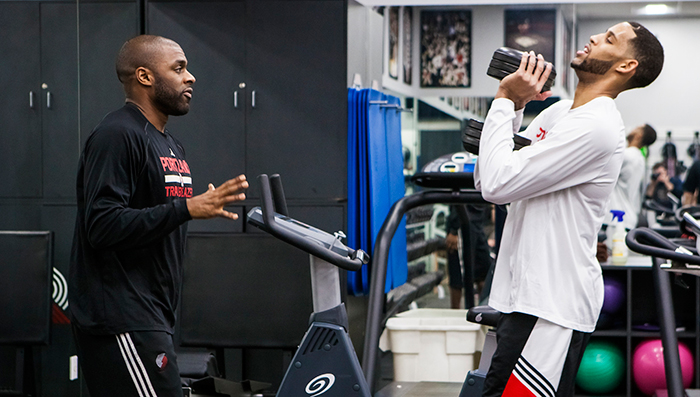
Ben Kenyon ’06 working with Will Barton
Before joining the Trail Blazers, Kenyon worked as an assistant athletic director for strength and conditioning at George Washington University. He enjoys the work despite a demanding schedule that sometimes has him in four different cities in five days. But it’s worth it, he said, to help players get quicker, faster and stronger or simply remain ready to contribute to one of the NBA’s best teams. Another payoff is the credibility the 6-foot-2 Kenyon has earned in a league of large men. “The ability to walk into a room and have a physical presence with these guys definitely helps,” he said. “To be able to tell these guys what they need to do with their bodies, you need to look the part.”
Protecting the Brain
Despite the best efforts of performance specialists like Kenyon, athletic trainers like Gavagan and coaches like Armas, athletes are still susceptible to concussions—brain injuries that, in some cases, heal in a few days, but in others, linger long enough to imperil careers.
“One thing I’m conscious of is how much air they put in the ball—it’s easy to overinflate a soccer ball,” Armas said. “If the ball’s overinflated, some of the little head traumas that happen during a match will become bigger problems.”
Fortunately for athletes, concussion protocol has changed for the better. Youth coaches are required to have concussion certification from the National Federation of State High School Associations. And sports leagues are making more of an effort to protect the athlete, too.
Student-athletes at Adelphi are given memory tests before the season to obtain a baseline score. If a player sustains a head injury in season, the same tests are done and the scores compared to assess the extent of the injury. If a player who sustains a concussion is symptom-free for seven days, then he or she can begin light jogging or ride an exercise bike. Only after a battery of tests is a concussed athlete medically cleared to return, usually after 10 days.
That’s not how it used to be. “Years ago, when an athlete suffered a concussion, the trainer came out with smelling salts,” said Dan Bedard, M.A., a clinical assistant professor in sport management at Adelphi and a former pro hockey goalie in France and Sweden. “Today, we understand that to use smelling salt to wake up an athlete is a clear sign that he should not be playing because he had been knocked out. If you’re in a car accident and you’ve been knocked out, nobody’s going to say, ‘Hey, get back in that car and drive home.’”
What Parents Can Do
A child suffering a concussion or some other serious injury is every parent’s nightmare. Nevertheless, parents should avoid becoming overanxious, which could spoil the child’s joy of performing, Dr. Chirban Donohoe said.
Parents should not assume the worst. The benefits for a child in taking part in sports or dance far outweigh the risks.
“I’m a low-anxiety athlete’s mom,” Dr. Chirban Donohoe said. “My 20-year-old daughter competes in regional figureskating competitions. Whether she’s doing a double lutz or a triple axel, I never know what [kind of jump] I’m looking at. What’s important is that she’s enjoying it.”
One more nugget for parents from Dr. Chirban Donohoe: Back off.
“I joke sometimes that kids need to be saved from their parents. There’s a term in sport psychology—achievement by proxy. The parent’s sense of self becomes defined by the child’s achievement. Have you ever met a hockey dad who claims his 4-year-old is bound for the National Hockey League?”
Armas, a six-time Major League Soccer All-Star, has sons, Christopher, 13, and Alexei, 10, in youth soccer. Still, he said it’s important for parents not to steer a child toward their favorite activity.
“Sometimes a parent will tell an 8-year-old, ‘OK, do this sport.’ But how does he know what an 8-year-old wants to do?” Armas said. “I’m Mr. Soccer Guy, and my boys play soccer. But they also play roller hockey, basketball, baseball and flag football. My wife and I don’t push them toward soccer. We tell them you don’t
For further information, please contact:
Todd Wilson
Strategic Communications DirectorÌý
p – 516.237.8634
e – twilson@adelphi.edu