Did climate change cause the super typhoon that devastated the Philippines?
For decades, some of the world’s top scientists have warned us that increasing levels of heat-trapping greenhouse gases would have a devastating effect on our planet. But just as Cassandra in Greek mythology was cursed with the power to foretell the future but never be believed, so predictions of climate change were met with a mixture of support, dispute and outright denial. At international climate summits, the United States failed to take up the mantle of global leadership, even as wildfires blazed, glaciers melted and Hurricane Katrina devastated New Orleans.
Then rolled up the East Coast and developed into something so far beyond a typical hurricane that the media dubbed it a superstorm. We’re listening now. Climate change is not something that’s going to happen in the far distant future. It’s here. Environmental advocates even say we’re on an altered planet and in a new era. Author Bill McKibben titled one of his books, saying our current term, Earth, is no longer suitable. In , Pulitzer Prize—winning author and journalist Thomas Friedman (who spoke at Adelphi on October 3, 2012) says we’ve moved from the Common Era (C.E., or A.D., as it was formerly termed) to the Energy-Climate Era. , physicist, author and former acting assistant secretary of the U.S. Department of Energy’s Office of Energy Efficiency and Renewable Energy, derides the terms global warming and climate change as euphemisms and prefers the more apt Hell and High Water, the title of his 2006 book. Even the is considering adopting the term AnthropoceneÌý(the Age of Man) to describe a new geologic epoch, one defined by massive human impact.
What changes will we see? Is there anything we, as U.S. and global citizens, can do? Do we have the wherewithal to address what many believe to be the most pressing problem facing humanity and life on Earth? Or will we emulate the Roman Emperor Nero and fiddle while fires burn and cities sink beneath the waves?
Our quest for answers took us from a National Aeronautics and Space Administration (NASA) scientist watching satellites far above the Earth to a professor who studies sediments dredged up from the seafloor. We spoke to alumni who are helping our most vulnerable citizens cope after extreme weather upends their lives. And we found some hope that if we act collectively to address this issue, we may yet have a chance of avoiding the worst-case scenarios of climate change.
, grew up in Malverne, New York, earned his B.S. in Chemistry at Adelphi, then continued to Caltech for his Ph.D. in Theoretical Physical Chemistry. In his current role as associate director of research at , he manages a team of scientists with access to an enormous array of data about the Earth, thanks to a flotilla of satellites that circle pole to pole, 16 times a day, year after year, in what Dr. Kaye calls a “marvelous scientific and engineering accomplishment.” Working in what are termed constellations, these satellites scan oceans, mountains, rain forests—even volcanoes—and supply scientists with information on sea temperatures, hurricanes, biology, oceans and groundwater, the atmosphere and clouds. Dr. Kaye’s team analyzes and interprets the data from years of observations. The findings are then inputted to produce computer models projecting what the Earth will be like in the future.
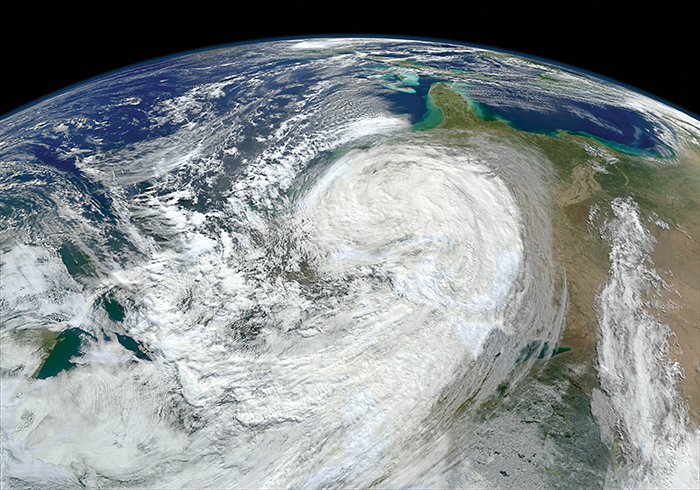
A View from Above
According to a draft of NASA’s report “Responding to the Challenge of Climate and Environmental Change: NASA’s Plan for a Climate-Centric Architecture for Earth Observations and Applications from Space” (January 2013), increased levels of greenhouse gases will have the following effects on the Northeastern United States:
- A greater number of heat waves, with the effect more pronounced in New York City, which will become whatÌýis termed an “urban heat island.”
- The Northeast will experience heavier rains and flooding, while, globally, dry areas will become drier and experience droughts.
- Melting sea ice will contribute to a rise in global sea levels, projected to rise between one and four feet by 2100. Sea level rise in the Northeast is expected to exceed the global average by up to about four inches per century.
- More intense storms, meaning that Sandy will most likely not be the storm of the century.
Storms and flooding will damage infrastructure. Heavier rains and droughts will affect agriculture and possibly result in escalating food prices or even shortages. As some species struggle to survive, other, less desirable ones such as mosquitoes and mold will happily adjust to a hotter, more humid climate. Our most vulnerable citizens—children, low-income, the elderly or disabled—are also the ones most likely to bear the brunt of climate change.
Dr. Kaye doesn’t have any easy solutions to our self-imposed dilemma. He emphasizes that he’s a scientist, not a politician, economist or businessperson. “Science is good at helping look at a scenario,” he says. “If you want to achieve a certain aim, what do you have to do? Or if you continue on the present course of action, what are the implications likely to be? But [science] doesn’t tell you what to do. Ultimately that’s a value judgment society has to make.”
Just as it took centuries for us to create this climatic cataclysm, it will take us as long—or even longer—to return to our preindustrial-era atmosphere “because carbon dioxide has a very long lifetime,” he explains. “But there are things you can do to minimize the damage you inflict on the global environment. The phrase used is you want to ‘avoid the unmanageable and manage the unavoidable.’”
Avoiding the unmanageable—or mitigation—means preventing the worst-case scenario from happening. The obvious answer is to reduce emissions of greenhouse gases. Dr. Kaye mentions carbon capping (providing economic incentives to reduce emissions), better fuel efficiency for vehicles, as well as more hybrid cars. “Buildings are some of the biggest users of fossil fuels for heating and cooling,” he adds. “You can retrofit buildings and design urban areas in ways that will require less use of energy,” which will be crucial in an urbanizing world—seven billion people projected to increase to approximately nine billion by 2050.
What about technology? Will someone invent a high-tech magic bullet that will really mitigate the greenhouse effect? Dr. Kaye mentions carbon sequestration (removing carbon dioxide from the air and sequestering it in aquifers or geologic formations).
Other researchers, he says, are looking into geoengineering, which involves modifying the environment on a large scale, such as shielding the Earth from some of the sun’s rays by either sending giant reflectors into orbit or injecting reflective particles into the atmosphere. He emphasizes, however, that playing with a planet can have unforeseen consequences, “So we have to be careful.”
The second challenge of climate change is adaptation, or managing the unavoidable changes that are likely to occur. Answers include rebuilding infrastructure to withstand predicted changes or even moving people out of coastal areas—an issue that came into play post-Sandy.
Dr. Kaye credits New York City Mayor Michael Bloomberg for the level of effort that went into his $20 billion storm protection plan. “New York City has been pretty aggressive in recognizing the vulnerability and beginning to think what some of the implications are,” he says. He’s not so sure about Long Island. “It’s low and flat and close to sea level,” he says. “People should understand that Long Island needs to take this seriously too. It’s hard [but you don’t] sit there and do nothing. When faced with a challenge, you’ve got to work that much harder.”
For years, world leaders have met everywhere from Rio de Janeiro to Kyoto to Copenhagen, discussing how to deal with climate change. The developed world, particularly the United States, is responsible for the highest amounts of greenhouse gas emissions. Ironically, we have the ability and resources to adapt or recoup after a major disaster. This is not so elsewhere in the world. “And as the rest of the world suffers, we will feel the effects indirectly,” Dr. Kaye says. “We can’t shut it out. From a humanitarian, ethical, moral and religious point of view, when we’re dealing with things that have disproportionate impacts on those that are the least able to deal with them, and in some cases aren’t responsible for them, what’s the right thing to do?”
That’s not to say we can’t make it happen. Dr. Kaye refers to when governments came together in 1987 to sign the Montreal Protocol to phase out ozone-depleting chlorofluorocarbons. “The nations of the world identified the threat and took action and we are beginning to see the beneficial environmental impacts of that,” he says. “So that’s not to say the world can’t step up and deal with these things, but it’s hard, especially when we’re dealing with something as central to the economy as fuel consumption. It’s not easy, but that doesn’t mean you don’t try.”
Caring About the Coasts
Beth Christensen, Ph.D., associate professor and director of the , doesn’t look at the earth from a satellite’s view; her head is more in the sand, so to speak—as in dune and beach sand that Sandy’s surge swept somewhere out to the bays. Dr. Christensen wants to know the whereabouts of this sand to understand the processes associated with major storms and the implications for beach replenishment and rebuilding the barrier islands that form a natural protection for our coastal communities.
In January 2013, supported by a University of Texas Rapid Response Grant, Dr. Christensen teamed up with researchers from the University of Texas and Stony Brook University to board an 80-foot boat that plied the waters off Fire Island and Long Beach.
It was an experience she sums up as “two women, eight men and two weeks of stinky boots.” The team used sophisticated sonar instruments to image the seafloor so they could distinguish beach sand from mud. Equipment then scooped up sediment samples that were scraped into bags for Dr. Christensen to examine further in her lab at Adelphi. She, Assistant Professor Jessica Dutton, Ph.D., and Adjunct Professor Christine O’Connell have been mapping debris “to understand how the surge behaved when it pushed into [the New Jersey coast and Long Island],” she says.
Storms don’t just shake up sand; they wash away the trappings of modern life—everything from soda machines to outdoor decks—and stir up toxins that sink to the seafloor. Dr. Christensen points out that densely populated Long Island is home to utilities such as power plants and sewage treatment facilities that can “impact the health of the sediments” by depositing poisons such as mercury and arsenic. She adds that copper from boat-bottom paint also “sinks to the seafloor and kills everything.”
Prior to Sandy, Dr. Christensen and her team had collected data on the toxin levels in the bays. As they analyze these levels in the sand and mud collected post-Sandy, they can evaluate where the sediment originated and where it traveled with the storm.
“It’s all part of learning from this horrible event,” she says. “There’s a very good chance that something like this will happen again. One of the saddest aspects of this storm is how it impacted vulnerable populations.” Dr. Christensen’s uncle was among those who perished in the storm’s aftermath. Years of heart problems were exacerbated by the stress of the storm, and Dr. Christensen feels this contributed to his death months after Sandy.
Helping Sandy Victims Find Hope
had no way of knowing that she would get a chance to practice her psychology and social work skills even before receiving her M.S.W. from Fordham University. She was with her family in their home in Midland Beach, Staten Island, about a mile and a half from the water, the night Sandy hit. Water flowed down her block, began filling the basement and then the first floor. Ms. Hettiarachchi and her family headed to the second floor, “trying to grab as much as we could,” she describes. They were rescued the next day by a New York City Police Department boat but had to spend a week in a shelter and then stay with an aunt until their house became livable again in mid-January.
While a student in the , Ms. Hettiarachchi interned with the Staten Island Mental Health Society. After Sandy, she contacted her former supervisor and was hired as a crisis counselor for Project Hope. Created by the New York State Office of Mental Health and funded by the Federal Emergency Management Agency (FEMA) to provide counseling for Sandy victims, Project Hope is administered by the Substance Abuse and Mental Health Services Administration (SAMHSA) to agencies in New York City, Nassau, Suffolk, Westchester and Rockland counties.
Long Beach resident Frances Alkire, M.S.W. ’05, saw her community decimated by Sandy. Then she lost her job as a substance abuse counselor for the Long Beach Medical Center when the building had to close due to storm damage. Ms. Alkire quickly found a position as a team leader at another Project Hope agency, South Shore Association for Independent Living, Inc. (SAIL), which serves residents in Long Beach and the Five Towns in Nassau County. She is joined by fellow alumni Ricky Demirakos, M.A. ’12, project coordinator, and Jacquelyn Dolan ’08, M.S.W. ’09, team leader.
All four alumni bear witness every day not just to the physical devastation of houses and infrastructure, but to the often invisible and continuing trauma that can leave people psychologically adrift after a disaster. “Many people are stagnant,” says Mr. Demirakos. “Some are suffering from anxiety or depression. Many were just keeping to themselves. We’re out there, knocking on doors and reaching out to the community.” Project Hope offers support groups that teach residents management and coping skills.
It Comes Down to Human Wishes
Spend some time outdoors on Adelphi’s Garden City campus with Department of Biology Professor George K. Russell, Ph.D., and you become aware of the natural world around you. He’ll tell you the best time of day to see rabbits grazing and about how he took his students to search the campus for birds’ nests or inspired his assistant to seek a wildflower he told her about. Dr. Russell is adept at linking humanities and nature, spirituality with the natural world, to make the sciences accessible to non-science majors. In addition to teaching, he served as editor-in-chief of Orion magazine for 20 years and has written and lectured on the ethics of animal use in teaching biology. He is a proponent of Waldorf Education, whichÌýadvises limiting the use of computers and electronics in favor of getting children outdoors.
Does he attribute our lack of concern over climate, ecological disasters and extinction as a result of our disconnect from nature? “Absolutely,” he says. “If you don’t cherish something, how can you be expected to protect it? If children aren’t connected, I worry that one day that disconnect will have a consequence. And that consequence is apathy and indifference.
“It’s like we’re asleep, somehow,” he continues. “Climate change is as daunting an issue as you can possibly imagine. But there is something in us that doesn’t want to hear these messages because there’s not a whole lot we can do. So we wall ourselves off from it, almost in self-preservation.”
Despite the dire odds against us, he sees hope. He cites the teachings of Jane Goodall, Ph.D., (the primatologist spoke at Adelphi on April 9, 2012) who believes that people do make a difference; in the environmental movement of the 1970s; and, like Dr. Kaye, in how Europe has taken much larger steps than we have to combat climate change, which they do “without reluctance,” Dr. Russell says, “because they care.”
It all comes down to people. “We made these things that are destroying the world,” Dr. Russell observes. “In the solution, we will have to address the question of why we did it. And it comes down to human wishes. In order to make change, we have to want things to change.”
For further information, please contact:
Todd Wilson
Strategic Communications DirectorÌý
p – 516.237.8634
e – twilson@adelphi.edu